Why I Stopped Buying Pre-Workout
I stopped buying pre-workout. Not because every ingredient is useless, but because once I understood what the ingredients were supposed to do, I realized I did not need a magic scoop. I needed a transparent formula.
I Stopped Buying Pre-Workout
I stopped buying pre-workout. Not because every ingredient is useless, but because once I understood what the ingredients were supposed to do, I realized I did not need a magic scoop. I needed a transparent formula.
A pre-workout is just a stack of mechanisms: stimulation, pump, buffering, hydration, fuel and ritual. If I know the mechanism, I can buy the ingredient directly, dose it properly, and remove the bullshit.
This is not a universal recipe. If you have medical conditions, blood-pressure issues, kidney disease, anxiety, sleep problems, take medications, or compete in tested sport, this is not a casual decision. From a coaching and self-experimentation angle, the framework is simple: define the problem, choose the ingredient, track the result.
Why commercial pre-workout bothered me
The issue is not that nothing works. It is that a product can feel strong because it has caffeine, while the actual performance ingredients are buried in proprietary blends or sitting below useful doses.
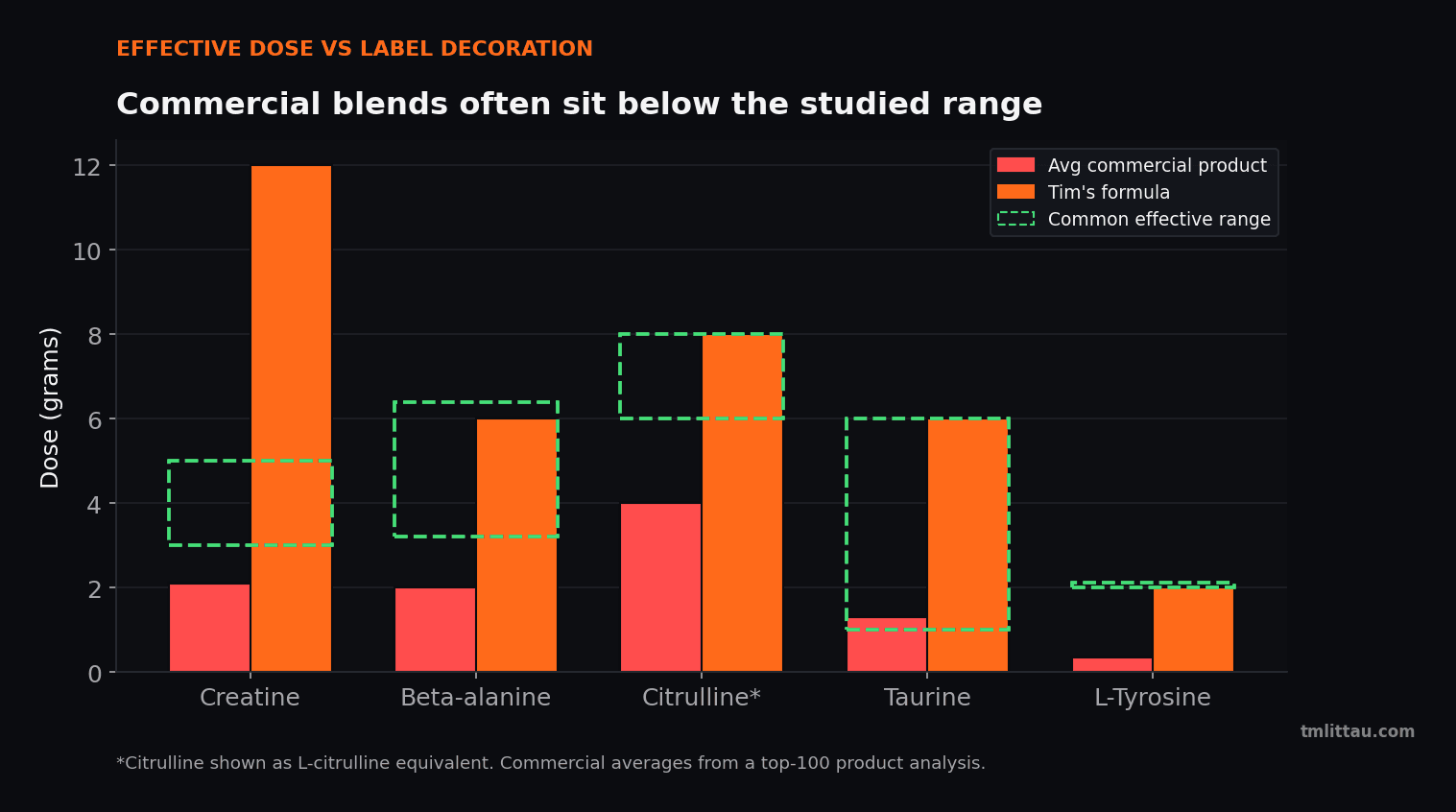
A top-100 product analysis found average amounts around beta-alanine 2.0 g, caffeine 254 mg, citrulline 4.0 g, tyrosine 0.35 g, taurine 1.3 g and creatine 2.1 g — several of those below the commonly studied effective range. The label looks scientific while the dose is built for sensation. That is exactly why buying single ingredients became more attractive: I can see the exact dose and decide what I am actually paying for.
Acute vs chronic: the concept that fixes most confusion
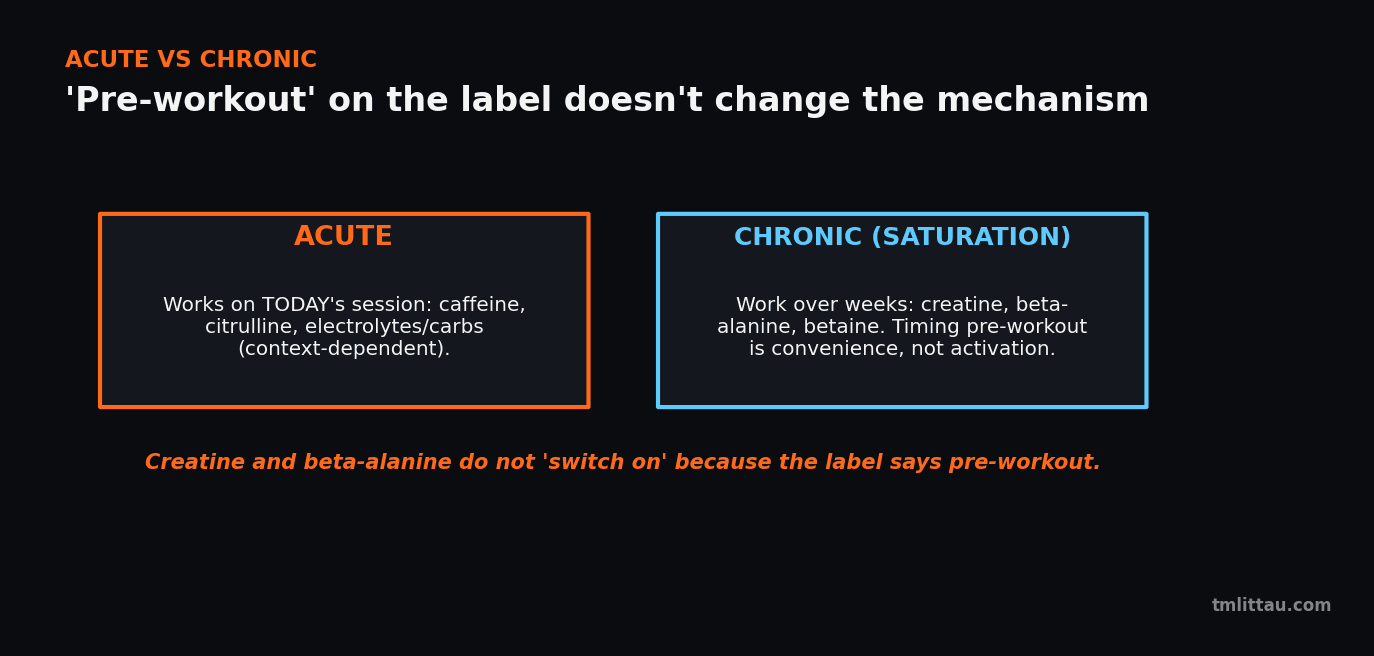
Some ingredients change today's session — caffeine, citrulline, sometimes electrolytes and carbs. Others work through saturation over weeks — creatine and beta-alanine. Taking the chronic ones pre-workout is convenient, but they do not suddenly activate because the label says "pre-workout."
My current formula
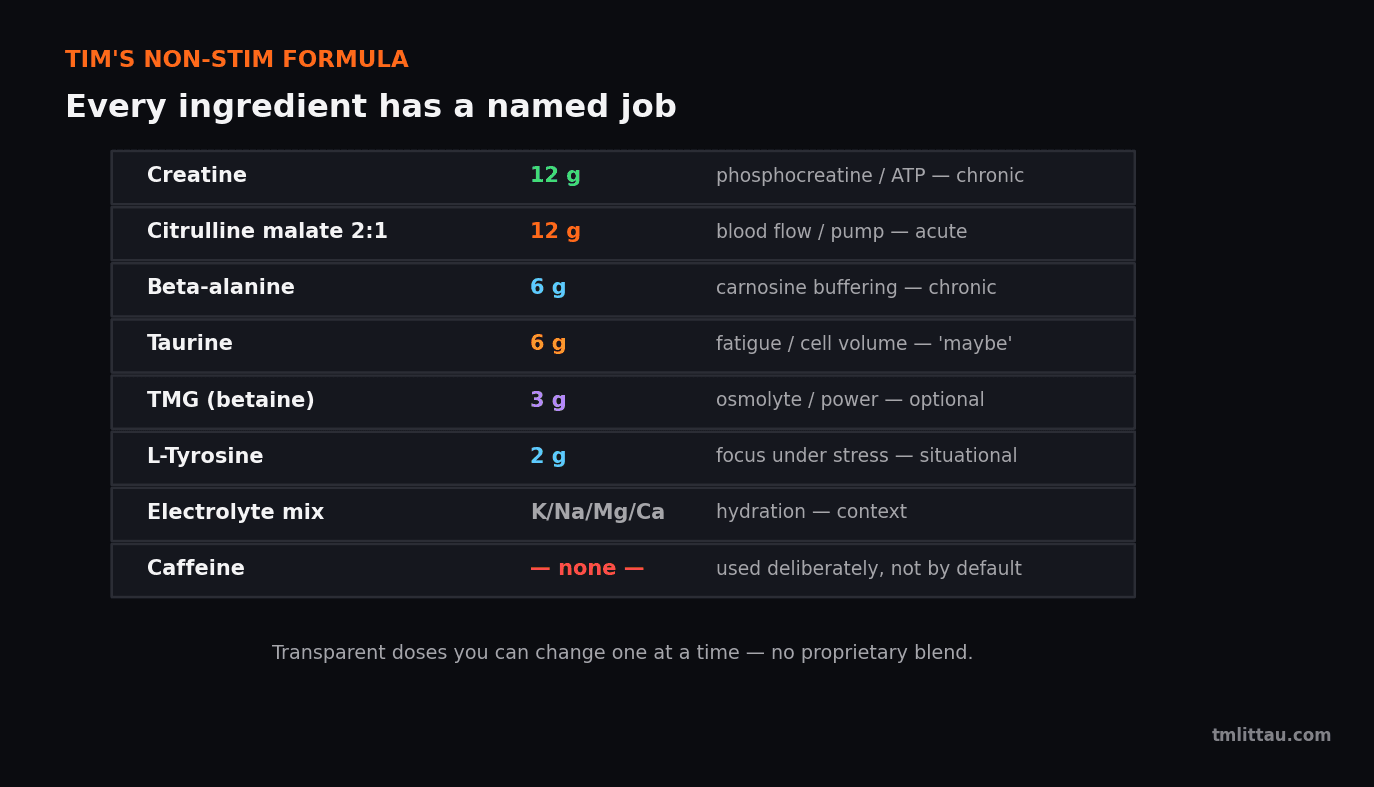
This is a high-dose, non-stim pump/buffering/readiness stack. It is not minimalist — but it is transparent. I know what each thing is supposed to do, and I can change one lever without guessing what was hidden in a blend.
A few honest notes on my own doses:
- Creatine (12 g) — one of the most evidence-backed supplements there is, but it is not a stimulant and doesn't need to be pre-workout. 12 g is more than most people need once saturated (3–5 g maintenance). Is that loading, body-size related, or just habit? If it's habit, that's worth testing down.
- Citrulline malate 2:1 (12 g) — about 8 g L-citrulline equivalent, a strong dose. May support blood flow and pump. Pump is a feeling; performance is an output — I won't promise guaranteed strength from it.
- Beta-alanine (6 g) — fits the research range. The effect is carnosine loading over weeks, not the tingling. If you hate the tingling, split the dose; the mechanism doesn't require suffering.
- Taurine (6 g) — a reasonable "maybe" for fatigue and cell volume, evidence less clean than caffeine or creatine (studied dosing is often ~1–3 g). My dose is high, so I'd watch GI tolerance and whether I notice a repeatable benefit.
- TMG / betaine (3 g) — a reasonable studied dose, but a weaker evidence tier. An optional lever that should earn its place through data and tolerance.
- L-Tyrosine (2 g) — focus under stress, not muscle. Possibly useful when sleep-deprived or mentally drained; a situational tool, not a hypertrophy ingredient.
The ingredient I deliberately left out
Caffeine. And caffeine works — but effective is not the same as always appropriate. If it improves today's session but ruins sleep, appetite, blood pressure or recovery, it can cost more than it gives. The point is to use caffeine deliberately, not to make every session dependent on a stimulant.
What I might add (context-specific)
Nitrate/beetroot for endurance or repeated efforts. Sodium bicarbonate for brutal high-intensity buffering, if my gut tolerates it. Carbs for long or glycogen-limited sessions. Theanine if I reintroduce caffeine and want smoother focus. Never everything at once.
How to actually test it
The only useful way to test pre-workout is one lever at a time. Fix the training session, fix the timing, and track performance, RPE, pump, GI symptoms, sleep and next-day fatigue. Change five ingredients and have a good workout, and you learned almost nothing. Change one and have the effect repeat, and now you have information.
So I stopped buying pre-workout because I wanted control — not a bigger scoop, not stronger marketing. Just fewer ingredients, better doses, clearer reasons, and better decisions. Build the formula around your actual problem, not the label that looks the most aggressive.
Mechanism → dose → context → decision.
🎥 Watch the full breakdown on YouTube: TML — Tim Littau
Educational content only — not medical advice or a universal prescription.
Sources
- Maughan RJ et al. — IOC consensus statement: dietary supplements and the high-performance athlete: https://pmc.ncbi.nlm.nih.gov/articles/PMC5867441/
- Kreider RB et al. — ISSN Position Stand: Creatine Supplementation: https://pmc.ncbi.nlm.nih.gov/articles/PMC5469049/
- Guest NS et al. — ISSN Position Stand: Caffeine and Exercise Performance (3–6 mg/kg): https://pmc.ncbi.nlm.nih.gov/articles/PMC7777221/
- Trexler ET et al. — ISSN Position Stand: Beta-Alanine (4–6 g/day; paraesthesia): https://pmc.ncbi.nlm.nih.gov/articles/PMC4501114/
- Critical review of citrulline malate and exercise performance (acute ~8 g CM): https://pmc.ncbi.nlm.nih.gov/articles/PMC8571142/
- Taurine in sport and exercise (typical ~1–3 g/day): https://pmc.ncbi.nlm.nih.gov/articles/PMC8152067/
- Chronic betaine supplementation and exercise performance (mixed evidence): https://pmc.ncbi.nlm.nih.gov/articles/PMC8419774/
- Sodium bicarbonate and exercise performance (0.2–0.5 g/kg; GI limits): https://pmc.ncbi.nlm.nih.gov/articles/PMC8427947/
- Common ingredient profiles of multi-ingredient pre-workout supplements (often underdosed): https://pmc.ncbi.nlm.nih.gov/articles/PMC6413194/
- Multi-ingredient pre-workout supplements: safety and performance: https://pmc.ncbi.nlm.nih.gov/articles/PMC6083567/
- Caffeine + theanine + tyrosine and performance: https://link.springer.com/article/10.1186/s12970-019-0326-3
- Tyrosine did not improve soccer performance (tempering claims): https://pmc.ncbi.nlm.nih.gov/articles/PMC11737745/
- NATA position statement: fluid replacement for the physically active: https://pmc.ncbi.nlm.nih.gov/articles/PMC5634236/
- ISSN Position Stand: Nutrient Timing: https://pmc.ncbi.nlm.nih.gov/articles/PMC5596471/
- Australian Institute of Sport — Supplement Framework: Group A: https://www.ausport.gov.au/ais/nutrition/supplements/group_a
- FDA — Dietary Supplements (regulatory framework): https://www.fda.gov/food/dietary-supplements