I built an app to coach myself
Five tracking apps that never talk to each other, and a coach left to stitch them together in his head. So I built the thing I actually wanted — one place where training, nutrition, bloodwork and the rest live on a single timeline, and the data does the coaching.
Track your training in one app. Your food in another. Supplements in a third. Bloodwork in a PDF your doctor emails you. Progress photos buried in your camera roll. Then try to make a real coaching decision from all of it at once. You can't — not properly. The data lives in five places that never talk to each other, and somewhere in the gaps, the signal gets lost.
That gap is exactly where a good coach earns their keep: they hold all of it in their head at the same time. I coach myself — so I did the engineer thing and built the tool I wished existed.
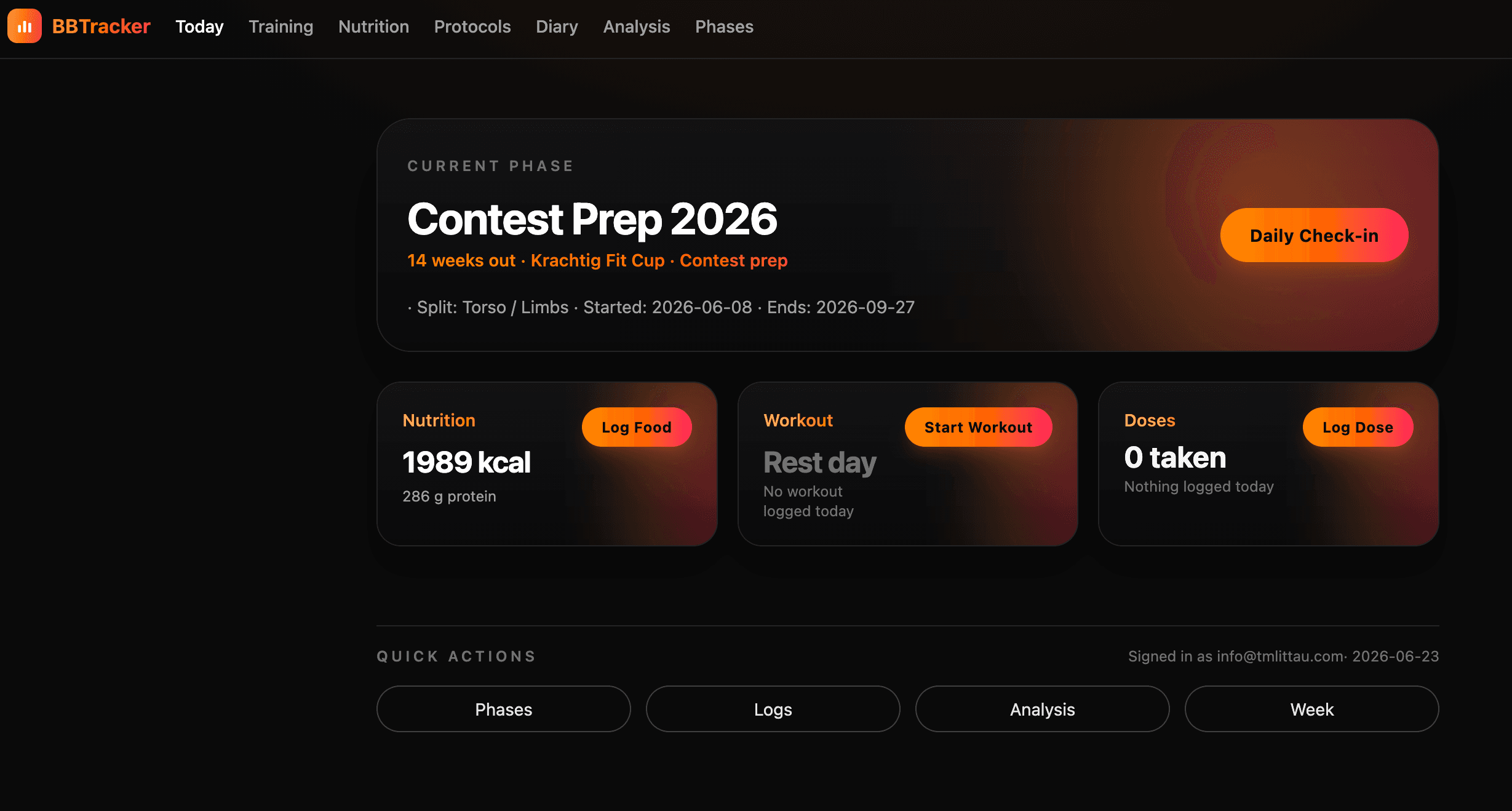
One timeline, not five apps
BBTracker puts the domains a coach actually reviews — training, nutrition, supplements and medications, and a progress diary — onto a single periodization timeline. Every workout, meal, dose and photo resolves to the phase it happened in. The dashboard answers one question: where am I today, across everything?
The point isn't tracking — it's the decision
Logging data is easy. The hard part is turning a month of it into a decision. So the app does the aggregation a coach does by hand:
- Training — estimated 1RM, PR detection, per-muscle volume and progression curves, so a plateau shows up as a flat line instead of a vague feeling.
- Nutrition — macros and micros against the phase's target, with barcode import so logging isn't a chore.
- An auto-generated weekly check-in — bodyweight trend, training output, nutrition adherence, doses, subjective wellbeing, photos and the latest bloodwork: the exact rollup I'd send a coach, built on its own.
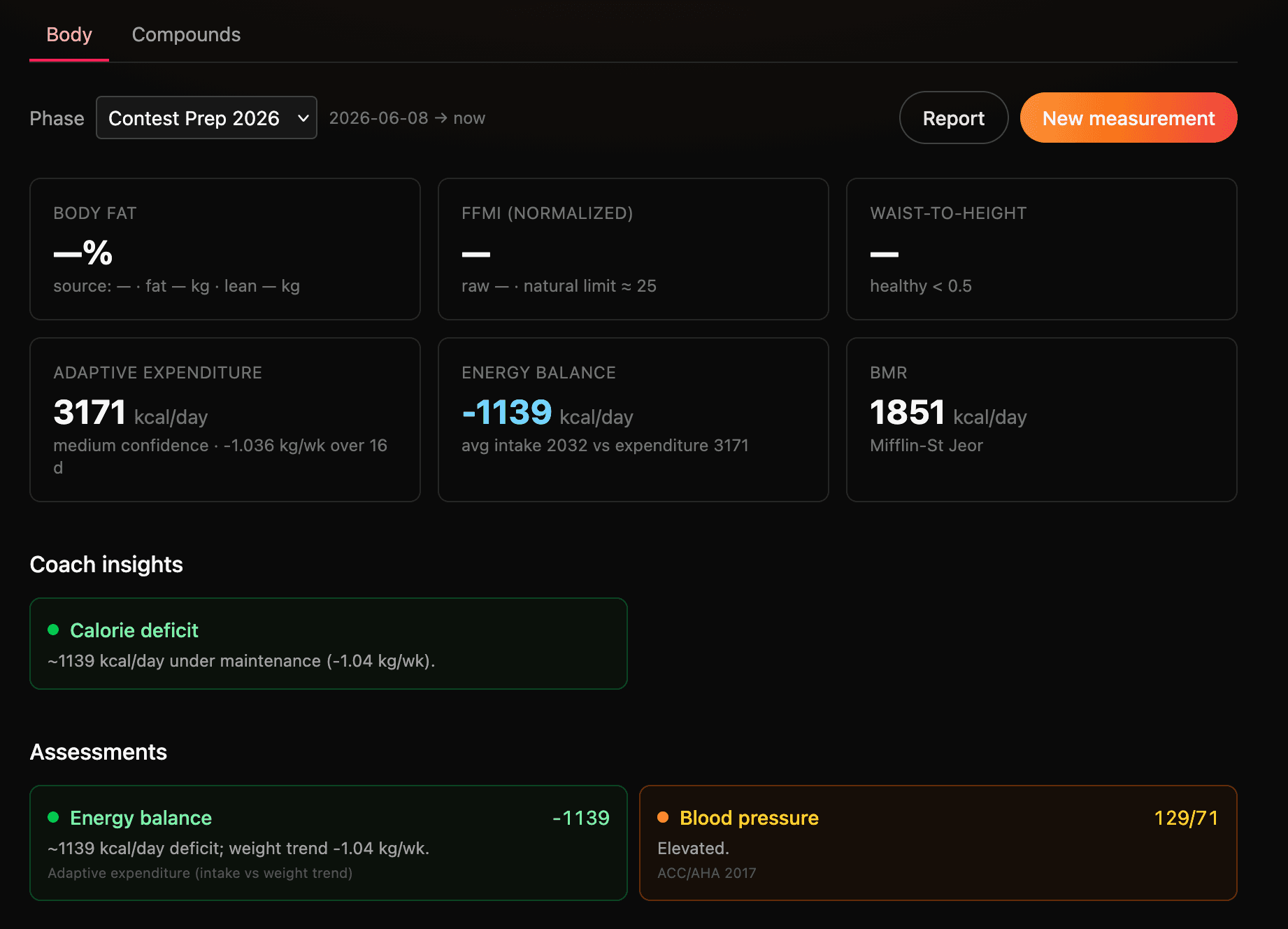
Where the engineering actually shows
A few things in here you won't find in a normal tracker — because they only make sense if you treat the body as a system with inputs and outputs:
- Pharmacokinetics, not guesswork. Compounds are modelled with their half-lives and ester constants, so a protocol plots as a release-rate curve over time rather than a number you hope is right.
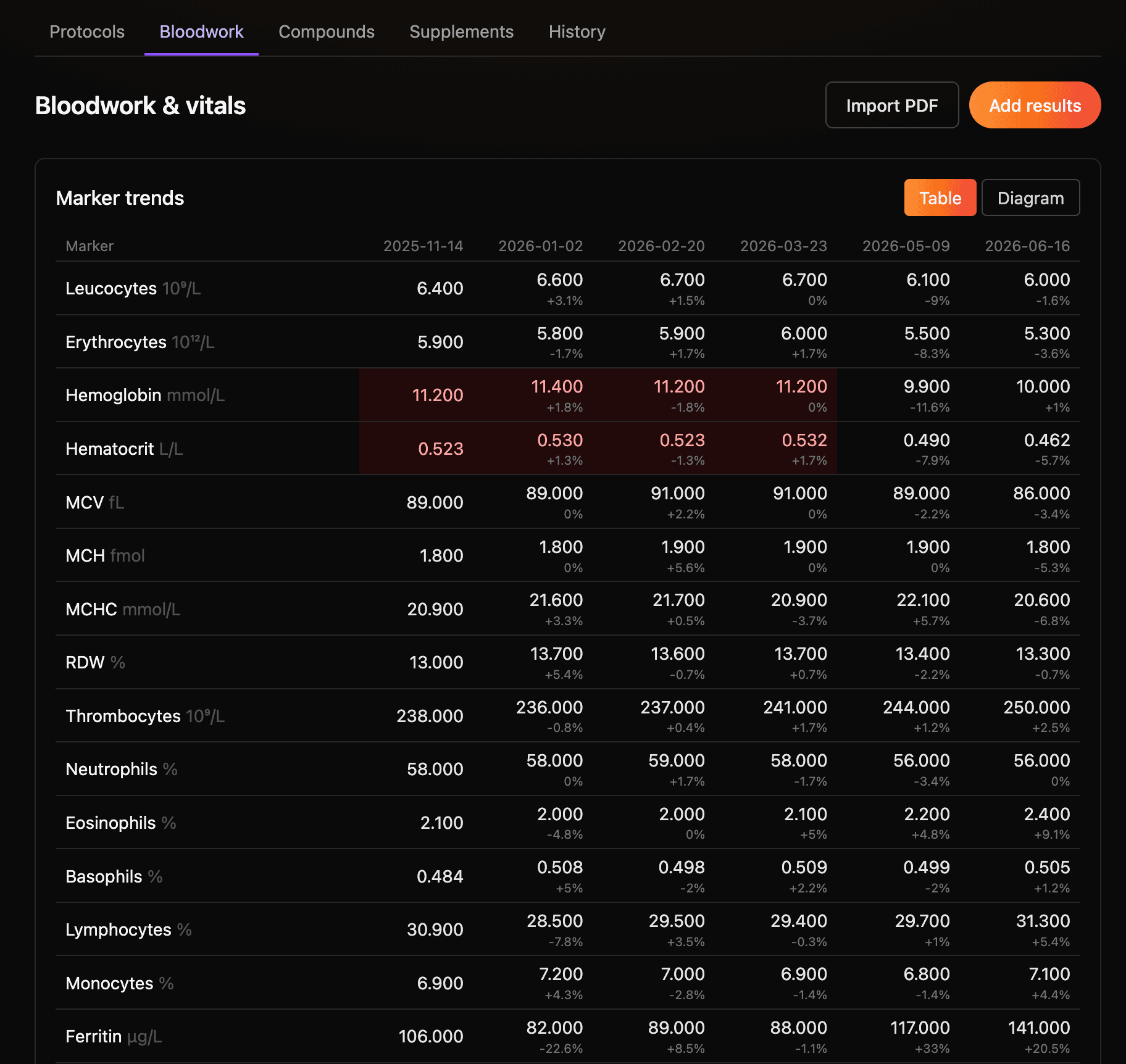
- Bloodwork that reads the trend. Upload a lab PDF and it pulls the markers, units and reference ranges into a trend matrix — out-of-range values flagged, the direction visible, derived metrics like free testosterone and eGFR computed for you. One reading is a data point; a series is information.
- Body composition from first principles. Navy body-fat, FFMI, and an adaptive TDEE that learns your real maintenance from intake-versus-weight over time. Math, not a bathroom-scale guess.
Privacy was non-negotiable
This is about as sensitive as personal data gets — health markers, body photos, medications. So it's self-hosted and private by default: my own server, two-factor auth, photos streamed through an owner-scoped API and never a public link. My data stays mine.
Why this fits everything else I do
It's the clearest example of the thing I keep banging on about: do the homework, then let the data make the call. I didn't want to coach myself on vibes — I wanted the same systematic, evidence-first approach I'd give anyone else, applied to me, with the receipts. BBTracker is the receipts.
It's a first version, and it's still evolving. But it already does the one thing I built it for: when it's time to change something, the decision comes from the chart, not the mirror.
🎥 Watch the full breakdown on YouTube: TML — Tim Littau
BBTracker is a personal tracking and journaling tool — not a medical device, and not medical advice. It records your own data and doesn't recommend or prescribe anything. Monitor your health with a qualified physician.